
The poster size describes the paper sheet, including the open space around the drawing. A square drawing can sit within a rectangular sheet with extra space above and below it.
Moda Minima offers six poster sizes, from 8 × 10 inches to 24 × 36 inches. The 12 × 12 option has square paper. The other five options have rectangular paper.
Compare the six paper sizes
These dimensions describe the poster sheet. A frame adds its own width, and a separate window mat can require a larger frame. The centimeter values below use 2.54 centimeters per inch.
| Poster sheet, inches | Poster sheet, centimeters | Width-to-height ratio |
|---|---|---|
| 8 × 10 | 20.32 × 25.40 | 4:5 |
| 12 × 12 | 30.48 × 30.48 | 1:1 |
| 12 × 16 | 30.48 × 40.64 | 3:4 |
| 16 × 20 | 40.64 × 50.80 | 4:5 |
| 18 × 24 | 45.72 × 60.96 | 3:4 |
| 24 × 36 | 60.96 × 91.44 | 2:3 |
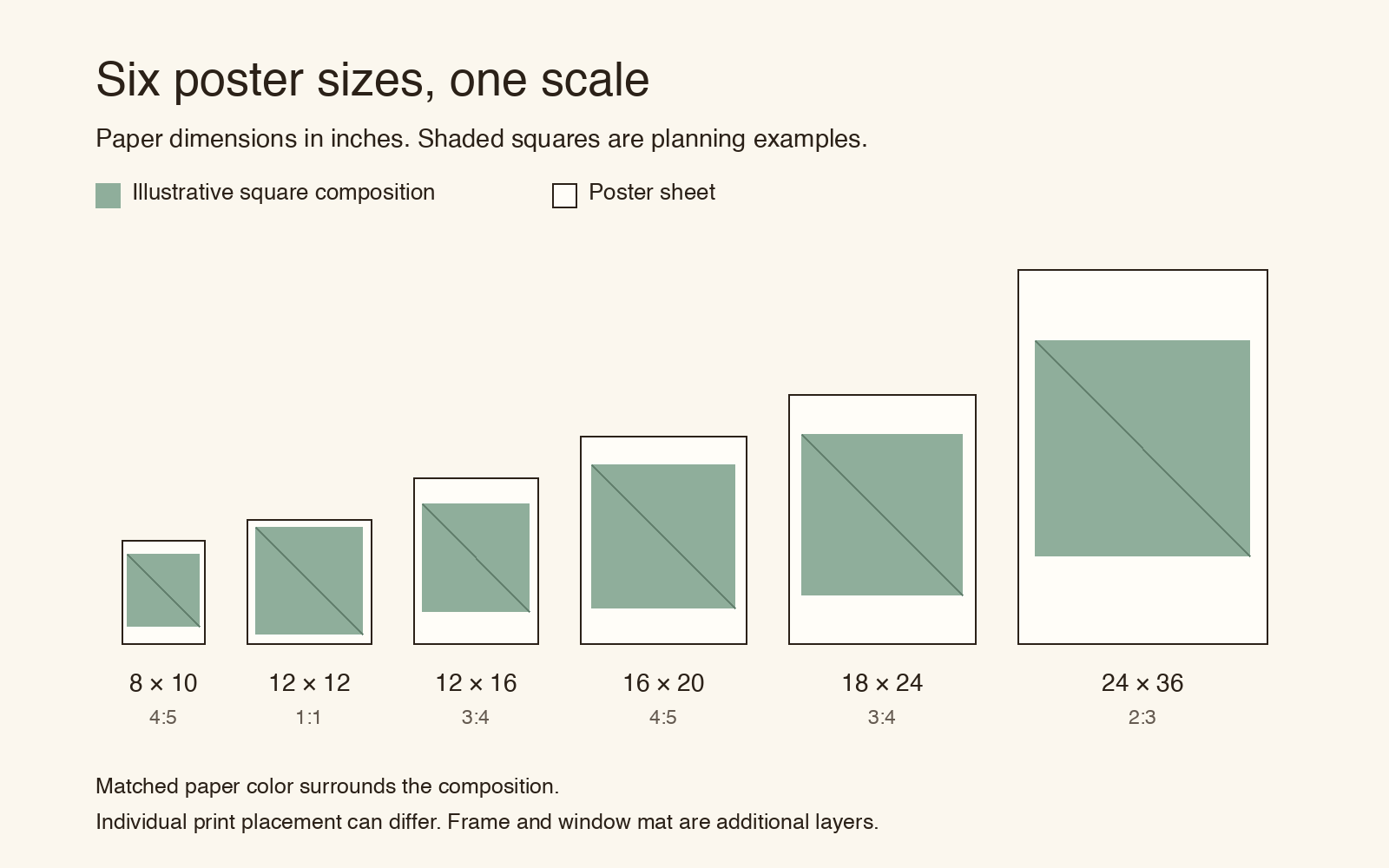
The 8 × 10 and 16 × 20 sheets share a ratio. The larger sheet has four times the area. The 12 × 16 and 18 × 24 sheets also share a ratio.
Separate the paper border from a window mat
Moda Minima compositions include open paper around the drawing. The poster preparation workflow places the artwork on a background that matches its paper color. That printed space is part of the poster sheet.
A window mat is a separate board with an opening. The Canadian Conservation Institute explains that this board separates the image from the frame glazing. Its guidance also calls for an opening that reveals the signature and other significant details.
A second mat changes the visible border and frame size. You can ask a framer for a layout that shows the intended composition and the small Moda Minima signature.
Read the illustration as a planning example
In the diagram, a hypothetical square occupies 86% of the sheet width. Equal side margins use 7% each. The top margin uses 45% of the vertical space left after placement.
On an illustrative 12 × 16 sheet, the square measures 10.32 inches across. The side margins measure 0.84 inches each. The remaining height gives about 2.56 inches above and 3.12 inches below the square.
The production workflow locates the artwork content before placement. Individual content bounds can differ, so these example margins do not specify a supplied print. A product preview also cannot establish the exact visible area inside your frame.
Test the size on your wall
- Measure the clear wall space around the intended position.
- Cut a paper template to one candidate poster size.
- Write the sheet dimensions on the template.
- Ask someone to hold the template at the intended position.
- Compare the template from your usual viewing position.
- Repeat the test with the next candidate size.
- Allow extra space for the outer frame dimensions.
- Check the visible opening against the artwork preview before you choose a mat.
A paper template tests physical scale. It does not reproduce the detail, color, or exact artwork placement of the finished poster. A photograph of your template can help you compare positions without marking the wall.
Use the frame measurements that matter
The poster sheet, frame opening, and outer frame each have different dimensions. A nominal 12 × 16 frame label alone does not describe its visible opening or external footprint.
For a separate mat, the framer needs both the sheet dimensions and the intended visible area. The Library of Congress recommends a window mat or spacers to keep paper from touching the glazing.
Choose two candidate sizes before you select the frame. Explore the collection. Compare the paper space around the drawings you like.
Sources
- Canadian Conservation Institute: Matting Works on Paper Reviewed 2026-10-23
- Library of Congress: Preservation Guidelines for Matting and Framing Reviewed 2026-10-23