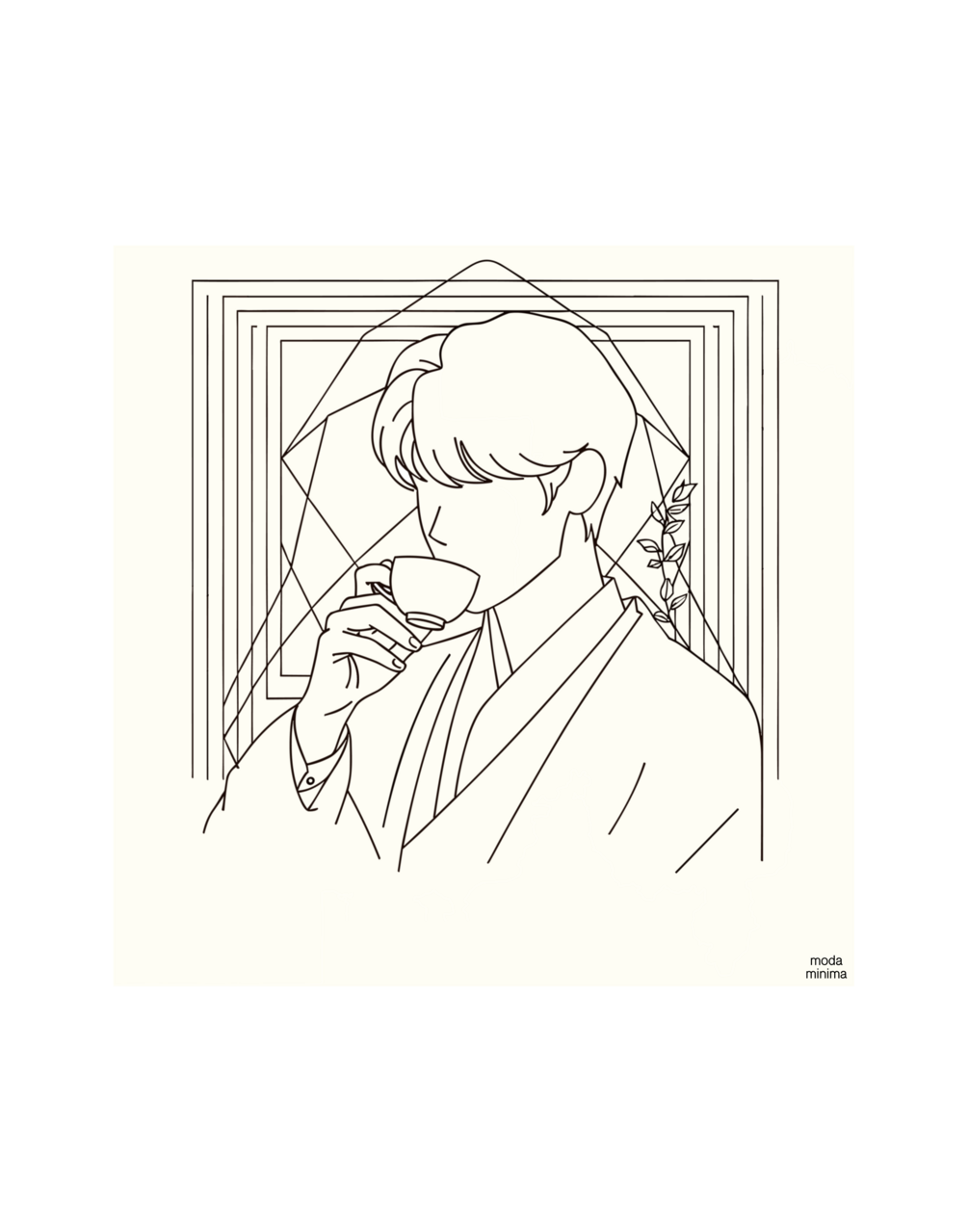
A cup can look ordinary until you notice where the fingers rest. A handle leaves a small opening. A lid changes the outline near the face.
In Quiet Cup, MM6, a person lifts a handled cup close to the face. The hand, curved handle, and cup rim occupy a small part of a larger drawing.
Two ways to hold a familiar object
Cup and Concrete, MM1, shows a different cup. It has a lid and a ribbed sleeve. The person holds it in front of the face, with rectangular grids behind the figure.
The objects give you visible details to compare before you invent a setting. The previews do not identify the drink or tell us when either pictured moment takes place.
You can notice the grip without deciding that one person feels relaxed or hurried. “Fingers around a sleeve” describes an action. “Late for work” adds a story.
A familiar object as a starting point
MoMA's Everyday Images and Objects uses everyday images and objects in artworks as subjects for discussion. This cup exercise begins with our own collection images. It makes no claim about their influence or history.
A cup nearby gives you another comparison. Its rim can be thick or narrow. The handle can leave room for one finger or a different grip.
| Original observation card | One place to begin | Your note |
|---|---|---|
| Outline | The rim, handle, or lid | Describe one visible shape. |
| Contact | The place where a hand meets the cup | Notice the grip. |
| Surroundings | One object beside the cup | Record a visible detail. |
| Association | A memory or imagined setting | Label this as your response. |
The card separates a visible detail from a personal association. Someone else can find the same handle. A memory connected with it belongs to you.
- Choose a cup already nearby.
- Describe its outline in one sentence.
- Compare one detail with Quiet Cup.
- Record any association in the final row.
There is no ideal morning routine here. You can use the card with tea after lunch or an empty cup on a shelf. The subject is the ordinary object you can see.
Quiet Cup and Cup and Concrete appear in the collection. Their familiar cups offer different details for the same small exercise.
Sources
- The Museum of Modern Art: Everyday Images and Objects Reviewed 2026-10-23
- Moda Minima: Quiet Cup, MM6, clean preview Reviewed 2026-10-23
- Moda Minima: Cup and Concrete, MM1, clean preview Reviewed 2026-10-23