
The 2/3 rule sizes wall art to the furniture below it. Art looks balanced when its width is about two thirds of the furniture's width.
An 84-inch sofa asks for art about 56 inches wide. Two 24 × 36 posters with an 8-inch gap between them reach 56 inches together.
The rule is a styling convention, and rooms break it when a piece deserves the space. Buy Wall Art describes it as art about two thirds the width of the furniture it hangs above. About Wall Art applies the same proportion across rooms.
What is the 2/3 rule for wall art?
The 2/3 rule means art about two thirds as wide as the furniture below it. A 60-inch piece of furniture asks for art about 40 inches wide. Designers use the ratio because a much smaller piece floats above big furniture, and an oversized piece crowds the wall.
Buy Wall Art states the rule as about two thirds of the furniture width. The same guide treats one large piece, or a set of two or three pieces, as ways to reach that width. Treat the rule as a starting point. Eye judgment and a paper template still matter.
Does the 2/3 rule apply to a bed or a console?
Yes. The same proportion applies to a headboard, a console, or a sideboard. Two adjustments change with the furniture. Above a headboard, Buy Wall Art places the bottom edge 6 to 10 inches above it. Above a table or console, the same guide asks for art over roughly two thirds of the table's width. It also asks for art that connects visually to the surface.
This measured example uses three fictional furniture widths and the six Moda Minima poster sheet sizes. Furniture is fictional. The sheet sizes come from the current catalog, from 8 × 10 to 24 × 36 inches.
| Fictional furniture | Two thirds of its width | Closest catalog choice | Combined art width |
|---|---|---|---|
| Sofa, 84 in | 56 in | Two 24 × 36 posters with an 8 in gap | 56 in |
| Bed, 60 in headboard | 40 in | Two 18 × 24 posters with a 4 in gap | 40 in |
| Console, 36 in | 24 in | One 24 × 36 poster, hung upright | 24 in |
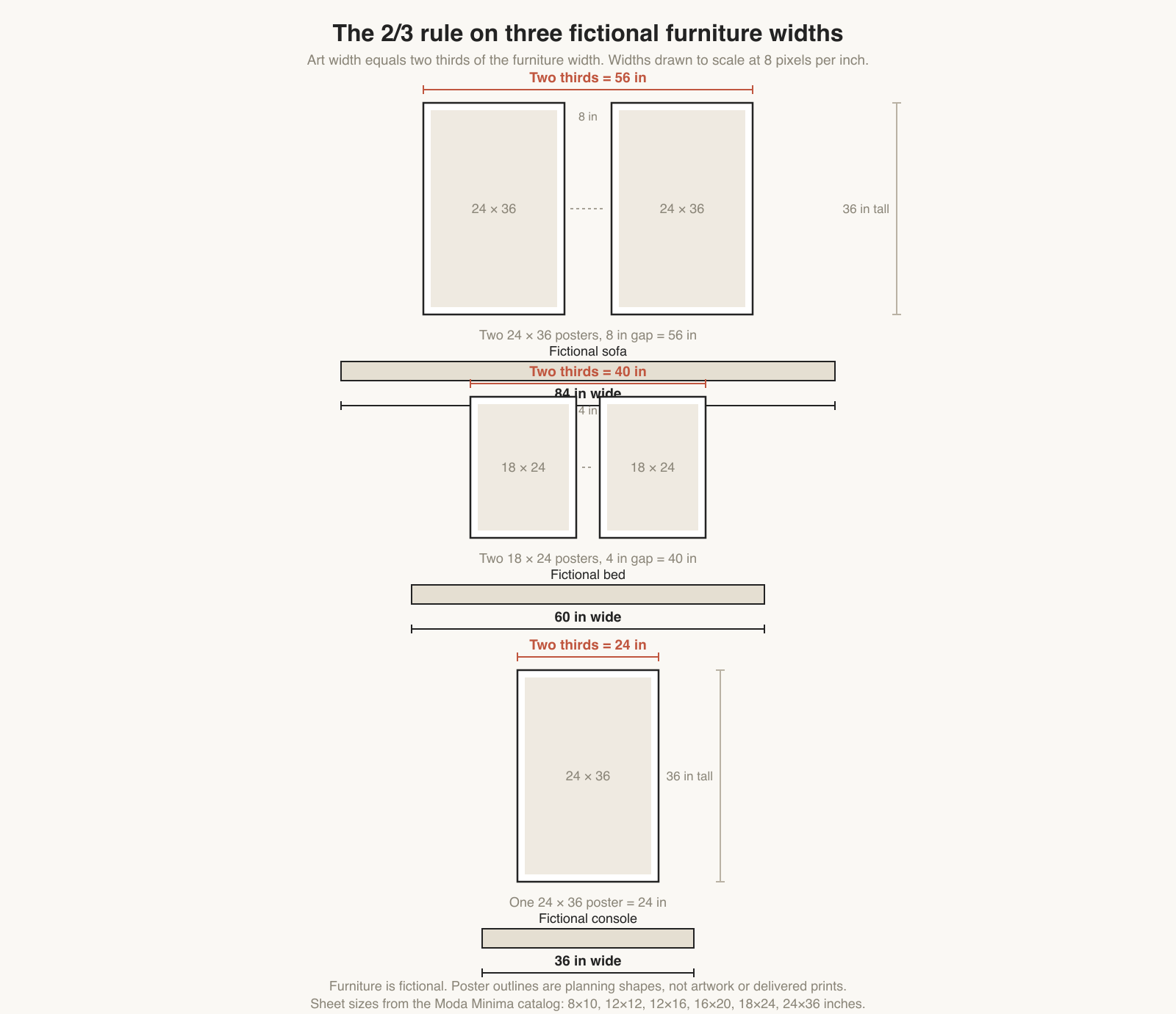
The console row shows the rule's limit. A 36-inch console asks for art 24 inches wide, and the 24 × 36 sheet is exactly 24 inches wide upright. Its full height is 36 inches, so check the wall above the console before you commit to that sheet.
What if one print is too small?
Hang a pair or a row instead. The combined width of the pieces plus the gaps between them is what you compare with the furniture. A 4-inch gap between two 18 × 24 posters turns 36 inches of paper into a 40-inch group.
A single calm figure can hold a wall on its own, and the collection has several. The Bench shows a man on a slatted bench in front of coloured triangles. Cloud Watching faces outlined clouds and a sun from a square block. Bridge Sitter hangs above a flowing stream of blue and green lines.
- Measure the furniture below your wall.
- Multiply its width by two and divide by three.
- Cut paper to the two thirds width and test it.
- Compare one large sheet against a pair with a gap.
- Add the frame's own width before you buy it.
The paper template test beats arithmetic at the wall. It shows how a group fills the space from your usual viewing spot, which is where the convention meets the room.
What is the 3-5-7 rule?
The 3-5-7 rule is a separate convention about odd-number groupings. About Wall Art explains it as styling objects or frames in groups of three, five, or seven, because odd counts read as intentional. Use it for how many pieces to gather, and use the 2/3 rule for the width of the group.
A pair breaks that odd-number habit and still works. About Wall Art calls even groupings formal symmetry: structured and calm, and intentional where a mirror-image arrangement is wanted.
Once you know the width you need, compare the six poster sizes in the size guide. It covers the paper border and frame choices that this guide leaves out. Browse the minimalist wall art shop page when you are ready to look at pieces.
Sources
- Buy Wall Art: What Is the 2/3 Rule for Wall Art? Reviewed 2026-10-24
- About Wall Art: What Is the 3-5-7 Rule in Decorating? Reviewed 2026-10-24